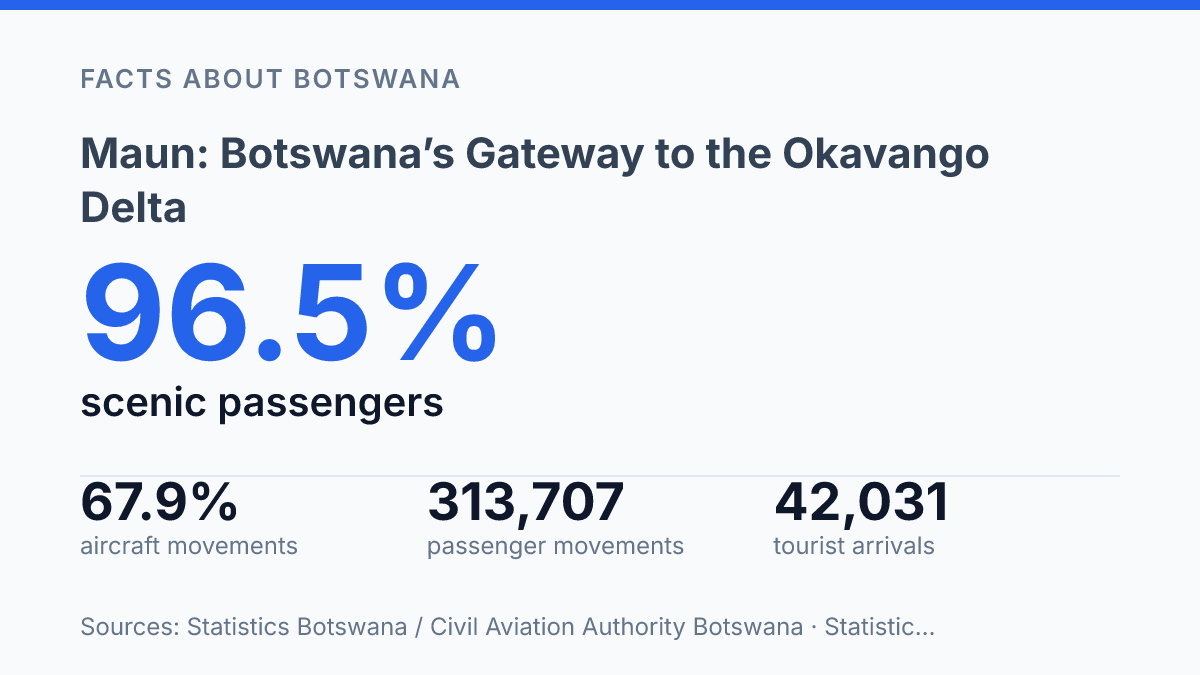
Maun handled 67.9% of every aircraft movement recorded in Botswana in 2024, a wild share for a town many travellers still treat as a place to pass through.
That number changes how you should see the town. The safari economy doesn’t begin at the lodge deck. It begins with fuel trucks, pilots, mechanics, food suppliers, booking desks, and workers who keep trips moving before anyone sees a mokoro.
The surprise is how ordinary it can look beside the Okavango Delta. A town of more than 85,000 people sits beside one of Africa’s great wetland systems, but its rhythms are practical: school runs, river levels, airport transfers, and heat rising off the tar. In my honest opinion, that’s what makes the place worth reading closely.
This guide looks at the machinery behind the safaris, the life along the Thamalakane. The clues that tell you what kind of place you’ve reached before the delta steals the spotlight.
Why Maun runs Botswana’s safari industry
Maun isn’t just near the Okavango safari trade. In 2024, its airport handled 67.9% of all aircraft movements recorded in Botswana, and 92.1% of its own movements were domestic, according to Statistics Botswana’s Transport & Infrastructure Statistics Report 2024.
That figure says more than any travel slogan. This is the air room where Botswana’s safari industry breathes.
That traffic explains why the town is known as Botswana’s tourism capital and remains the main launch point for Okavango Delta safaris. Travellers arrive with soft bags and tight schedules. Within hours, many are moving again toward lodge airstrips, mobile camps, or charter flights that stitch the delta together.
Maun International Airport gives that system its speed. It connects scheduled arrivals with small aircraft built for short hops into remote concessions. A guest can land from a regional flight, clear the formalities, meet a pilot, and be airborne again before the dust has settled outside the terminal.
The real power sits beyond the runway, though. Safari operators, guides, booking offices, vehicle yards, mechanics, pilots, caterers, and supply teams all cluster here.
The delta may deliver the spectacle. The town handles the calls, permits, fuel, food, spare parts, and staff movements that make the spectacle possible.
There’s a sharp contrast at the heart of it. The town sells access to wilderness.
It isn’t wilderness. It’s noisy, practical, commercial, and sometimes rough around the edges. In my view, that friction is exactly why it works.
A polished resort town would be less useful. This place functions like a workshop for the safari economy: planes come in, tyres get changed, coolers are packed, guides get briefed, and nervous first-timers become passengers.
If you’re heading into the Okavango, you don’t just pass through a gateway. You pass through the machine that keeps the whole experience moving.
What life looks like on the Thamalakane River
The oddest thing about the Thamalakane River is that it can make a town of 85,350 people feel half-built and half-wild. Statistics Botswana’s 2022 census confirms the town has real scale, yet its river edge keeps breaking the illusion of a neat urban center.
The settlement sits along the river rather than above it. That matters. Roads, homes, lodges, shops, yards, and footpaths all seem to negotiate with the water, not dominate it.
When the channel is generous, it softens the heat and draws life toward its banks. When it shrinks, the town feels exposed.
You see the contrast fast. A supermarket or fuel station may sit minutes from a sand track, a cattle kraal, or a cluster of traditional homes. Goats wander where traffic should have the final say.
Donkeys stand in the road with total confidence. Birdlife appears in ordinary places, not just in protected areas.
That mix gives the town its edge. It has modern services. It doesn’t behave like a polished city.
The built-up parts don’t erase the older settlement pattern around them. They sit beside it, sometimes awkwardly, sometimes beautifully.
The river gives the town life. It also stops it from feeling controlled. Seasonal water, loose sand, roaming animals, and scattered development create a kind of disorder you can’t plan away. In my honest opinion, that untidy quality is exactly what makes the place feel honest.
This is why “frontier town” fits better than “resort town.” The phrase isn’t about remoteness alone. It’s about a place where domestic life, commerce, livestock, and wild nature still rub against one another in public.
Nothing feels staged. That can be inconvenient, but it’s also the point.
How to read Maun before you arrive
The last reliable supermarket shelf before the sand tracks and concession roads may matter more to your trip than any viewpoint in town.
Read the town through its errands. Fuel stops are not background noise here.
They’re part of the route plan for anyone heading north toward the Panhandle or west toward drier country. Supermarkets, bottle stores, pharmacies, tyre shops, outdoor suppliers, and hardware counters carry the small failures that remote travel turns into big problems.
Lodges inside town serve a different purpose from lodges deep in the delta. They give you a soft landing, a secure parking spot, a shower, and time to repack before the next leg. That sounds plain, but plain is the point.
Short stays can feel oddly thin. You arrive, buy water, check batteries, sleep one night, and leave before the place has had time to explain itself. Longer overland trips and fly-in safari schedules depend on that same plain machinery for food, fuel, linen, staff movement, vehicle repairs, and last-minute replacements.
That’s the tension people miss. They treat the town like a pause between better-known experiences. The service economy here is what makes remote travel work at all. In my humble opinion, the useful version of the town is more honest than the polished one visitors expect.
In 2024, Botswana had 50,535 people employed in tourism-related industries, according to Statistics Botswana. Accommodation and food service made up the largest share. Those numbers help explain why so much of the town feels practical rather than decorative.
Scale also changes how you read the place. The Okavango Delta Ramsar Site covers 55,374 km², or nearly half of Ngamiland, according to the Okavango Delta Management Plan 2021–2028. A settlement on the edge of that kind of wetland has to function as a storehouse, repair yard, rest point, and decision point.
So don’t arrive looking only for attractions. Look for what people are loading, fixing, weighing, freezing, stacking, and sending out. That is the real pre-delta language of the town.
What makes the town feel so different from the delta
The wildest thing about the gateway is how quickly safari romance turns into errands, wages, land disputes, and diesel dust. Visitors tend to fold the town and the Okavango Delta into one mental picture.
That shortcut works on an itinerary. It blurs the real divide.
One is a lived settlement under growth pressure. The other is a protected wetland sold through silence, distance, and scarcity.
The two depend on each other. They don’t feel alike at all.
Development pushes outward from the town in ways that conservation can’t ignore. Plots need roads and boreholes. Tourism needs staff housing and storage yards.
Local families need room to build. Those needs don’t line up neatly with habitat protection.
The pressure shows up hardest when water fails. During April 2024, VOA and AFP reported about 500 hippos stranded in drying water sources in northwest Botswana, with more than 200 at Nxaraga lagoon near the town.
That isn’t a distant wildlife story. It’s what happens when animals, people, drought, and settlement meet at the same edge.
That is the part polished safari marketing edits out. Conservation here is not only a boundary on a map. It is an argument over water, grazing, jobs, access, and what happens when animals move beyond the spaces visitors imagine as remote.
In my view, the town matters most when it refuses to behave like the wilderness people came to see. Its biggest strength is also its flaw: it makes wilderness travel ordinary, messy, and human. You see the invoices behind the dream.
The delta offers distance, control. The feeling of being removed from ordinary life.
The town offers fuel fumes, half-finished buildings, working yards, domestic routines, and people trying to make a living from proximity to protected nature. Treating them as one experience flattens both.
So the contrast is simple, but sharp. The town feels practical, improvised, and lived-in. The delta feels guarded, remote, and carefully kept apart.
What the river and runway are trying to tell you
Book the flight, but don’t let the itinerary flatten the town into a transfer point. Regional routes added from Johannesburg on September 1, 2024 make access easier, and easier access always changes a place. More seats mean more jobs, more pressure, and more visitors who need to arrive with sharper eyes.
Use your first hour well. Watch the Thamalakane River, ask where the water is, and notice who is working behind the safari polish.
The drought that left about 500 hippos stranded in northwest Botswana wasn’t a distant wildlife story. It was a warning at the town’s edge. In my humble opinion, the smartest traveller treats the runway as the start of the lesson, not the end of the planning.
Frequently Asked Questions
Q: Why is Maun the main base for visiting the Okavango Delta?
A: Maun sits on the edge of the Delta and acts as the clearest launch point for trips in and out. It’s also the tourism capital of Botswana, so you’ll find safari operators, flights, and transport all in one place. That makes the town practical, even if it feels rough around the edges.
Q: What is Maun like as a town?
A: Maun is a frontier town, not a polished resort stop. Modern shops and safari headquarters sit beside traditional villages, roaming livestock, and wildlife… and that mix is exactly what makes it memorable. In my view, the contrast is the point, not a flaw.
Q: How do you get to the Okavango Delta from Maun?
A: Most visitors leave from Maun by air or road, depending on where they’re staying in the Delta. Maun International Airport handles the flow of travelers, so it’s the main air link for safari camps and lodge transfers. If you’re short on time, flying makes the most sense.
Q: Is Maun just a stopover, or is it worth staying in?
A: You can use Maun as a quick overnight stop, but that’s not the only smart move. The town gives you a real feel for northern Botswana before you head deeper into the Delta. In my honest opinion, that local edge is what many travelers miss when they rush through.
Q: What should I expect when visiting Maun?
A: Expect a working town with a strong safari rhythm, not a neat tourist bubble. You’ll see a mix of airport traffic, shopfronts, and everyday village life all in one place. That overlap is what gives Maun its character. It’s busy, practical, and close to the wild.