Francistown holds 103,417 people, but its weight in Botswana is bigger than a census line can explain. The name traces to Daniel Francis, who acquired prospecting licences in 1869. The city’s official founding story starts when the railway reached Monarch on 1 September 1897.
That split matters. One story is about extraction. The other is about movement.
Ask what the city is known for and you don’t get one clean answer. You get gold, rail, northern trade, civic pride, planning strain, and names locals actually use: “Ghetto,” “F-Town,” “Capital of the North.” In my honest opinion, the nicknames tell you as much as the plaques. This guide separates the official record from the way the place lives in Botswana’s imagination, then puts one national population fact beside it so the scale finally makes sense.
Why Francistown matters in Botswana
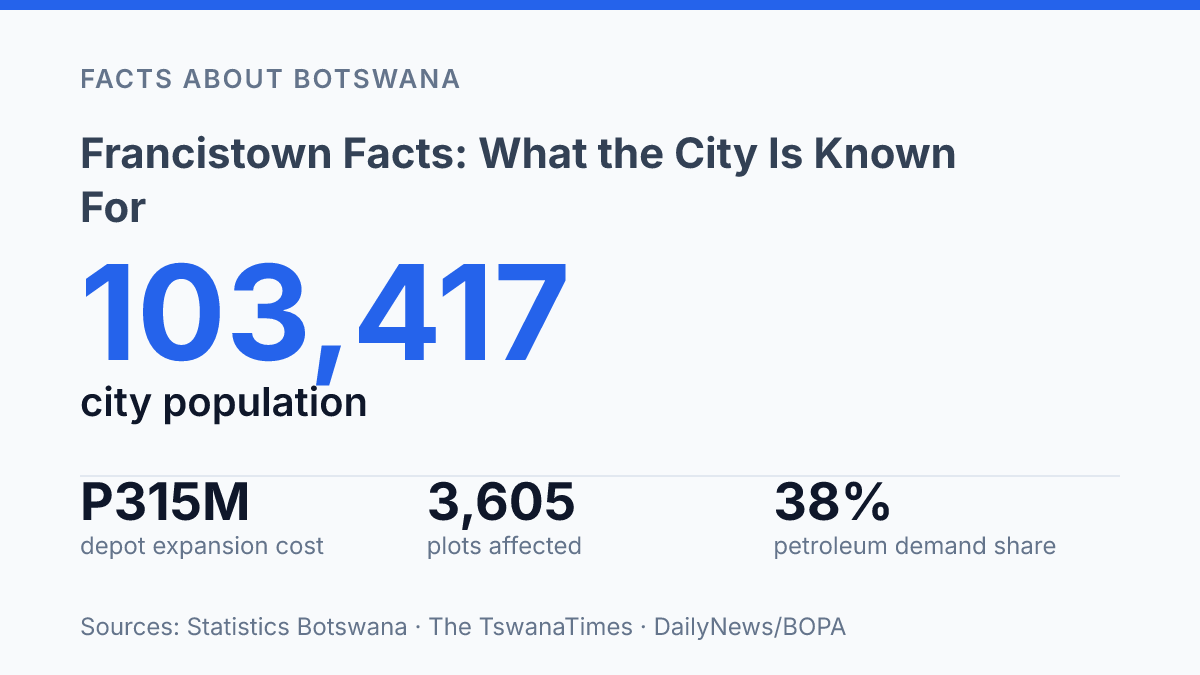
Francistown has only 103,417 residents, according to Statistics Botswana’s 2022 census, but its reach across northern Botswana is far larger than that headcount suggests.
In the northeast, close to the Zimbabwe border, the city sits where movement matters. People, freight, fuel, and services pass through it on the way to mining areas, farms, villages, and cross-border trade routes. That position gives it a practical importance you don’t always see in population rankings.
Its older claim to fame comes from the goldfields around Tati. DailyNews/BOPA has linked the wider area to Southern Africa’s first gold rush, long before the modern city took shape.
The mining story is not just a museum piece either. It still shapes how people talk about the place: hard-working, commercial, northern, and tied to extraction and transport.
The catch is status. This is a major urban center. It doesn’t carry Gaborone’s political weight.
The capital gets the ministries, the diplomatic traffic. The national spotlight. The northern city gets a different kind of power: roads, rails, supply chains, and regional loyalty.
In my view, that gap is exactly why the city matters. It shows Botswana isn’t defined only by its capital. A place can sit outside the main political stage and still anchor a whole side of the country.
How the city got its name
The city’s name looks like a surname on a map. It points to mining paperwork as much as to a person.
The link runs through Daniel Francis, a British trader and prospector whose interests in the Tati area helped fix the name in local use. Botswana Tourism Organisation says Francis acquired prospecting licences in 1869, and those claims became part of the story behind the town’s later identity.
By the 1890s, Francis wasn’t just a man looking for minerals. He was tied to concession-holding and trading networks around Tati, where outside capital chased mineral rights on land with a much older local history. That’s the messy part.
The name sounds clean and simple. It hides a story shaped by claims, companies, outsiders, and local ground that already mattered before it appeared in colonial business records.
Francistown took its name from Francis and the commercial world attached to him, not from a neutral geographic feature. The connection is usually traced to his concessions or company interests in the Tati district. That makes the name practical, but also loaded. In my honest opinion, the most revealing thing about it is how casually a business-linked surname came to stand for a place with deeper roots than the paperwork admits.
The local setting matters here. Tati wasn’t an empty backdrop waiting for a prospector’s name. It was part of a region already connected to mining, settlement, movement, and local authority. The later railway-era town gained an official shape around this history.
The City of Francistown Council dates its founding to 1 September 1897 and notes that city status came when it turned 100 years old. The name stuck. It never tells the whole story by itself.
What people mean when they talk about Francistown
The old gold label is only half the story. The city’s modern meaning is closer to a northern service capital than a mining relic.
When people bring up the city, they usually mean three things at once. First comes the association with the Tati region, where gold gave the place its durable identity. That history still explains why mining language sticks to its reputation, even when the mines are not the main everyday story.
Trade is the sharper clue to its present role. The city sits in the mental map of merchants, truckers, wholesalers, and public agencies as a practical stop on routes linking Botswana with Zimbabwe.
Goods move through, people change buses, services cluster there. The northern economy uses it as a point of reference.
That shift matters. Mining built the name, but movement keeps the city relevant now. In my humble opinion, the trade story says more about its current weight than the old gold story alone. A place can inherit its identity from the ground and still earn its importance from the road.
The civic marker backs that up. For a current population answer, Statistics Botswana recorded the city at 103,417 people in the 2022 census. That makes it one of Botswana’s largest urban centres outside the capital, not just a historic mining settlement with a famous past.
Local shorthand points the same way. Labels such as “Capital of the North” and “Hub to the North” don’t work unless a city serves people beyond its municipal line. They stick because the place handles commerce, administration, transport, and northern ambition in one compact urban centre.
One Botswana fact that puts the city in context
Botswana’s best-known mineral story starts with diamonds found in 1967, not with the older gold story that shaped the northern city. That contrast matters.
The country is one of Africa’s major diamond producers. This city’s identity was built on gold… and that difference says a lot about Botswana.
Diamonds became a national engine. After the Orapa discovery, the state built revenue through major mining partnerships, especially Debswana. That money helped fund schools, roads, health care, and public services at a scale gold never gave the northern city.
The better comparison isn’t just mineral against mineral. Think of Botswana’s global image: the Okavango Delta, wildlife tourism, open water in a dry country. Then set that beside diamond exports.
One picture sells wilderness. The other pays bills.
Population adds another layer. Botswana had 2,359,609 people in 2022, according to the national statistics office’s 2022/23 annual report. In a country that size, a city can hold national weight without being the capital or the main source of state wealth.
Gold gave the city its historical character, its hard-edged mining reputation, and much of the reason people remember it. Diamonds gave modern Botswana its fiscal muscle. In my view, that split is the cleanest way to understand the city’s place in the country: locally symbolic, nationally framed by a different mineral story.
What the nicknames can’t settle
The sharper question now is not what label sticks, but what the city does with pressure. In 2024, the Botswana Oil depot expansion put real money behind the northern-hub idea: P315 million, hundreds of jobs. A fuel role tied to demand across the north-east.
But growth can expose what pride hides. Serviced plots, water works, and civic naming debates show a place still deciding how to carry its past without being trapped by it. In my humble opinion, that tension is the most useful fact here.
If you want to understand the city beyond trivia, watch where the next pipes, depots, roads, and names go. A place reveals itself when ambition meets the bill.
Frequently Asked Questions
Q: What is Francistown known for?
A: Francistown is known as Botswana’s second-largest city and a major commercial hub in the north. It grew around mining and trade, but today its role is broader… people use it as a transport link, a business base. A stopover for travel deeper into the region.
Q: How did Francistown get its name?
A: The city was named after Daniel Francis, a British trader who held mining claims in the area. That colonial origin still shapes the story of the city. The place itself has moved far beyond that first chapter.
Q: What is an interesting fact about Botswana?
A: Botswana is one of Africa’s most stable countries. It has a strong reputation for careful governance. 1966 is the key date here, because that’s when the country gained independence from Britain.
Q: How many people live in Francistown?
A: Francistown has a population of about 103,000 people. That’s large enough to give the city real weight. It still feels smaller and more manageable than Botswana’s capital.
Q: Is Francistown a good place to visit or stay?
A: Yes, especially if you want a practical base in northern Botswana. In my view, what stands out is that it feels useful rather than showy. That makes it easy to underestimate. You get access, services. A real city pace without the pressure of a bigger capital.