
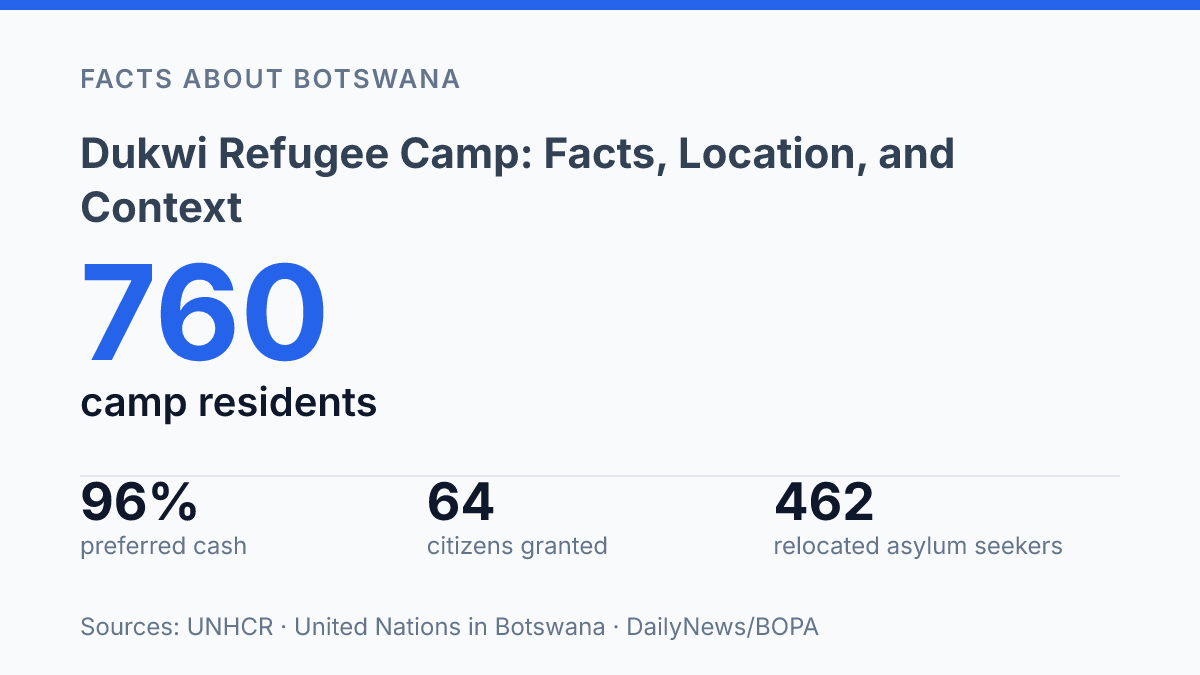
Dukwi refugee camp holds 760 refugees and asylum-seekers in a village of 4,075. That makes the camp roughly one-fifth of the local population, not a footnote to it.
The distance matters too. Dukwi sits about 580 km from Gaborone, yet UNHCR lists only three protection staff tied to the operation in 2026.
Small place. Heavy brief.
This guide treats Dukwi as more than a dot on a Botswana map. You’ll see why its location shapes services, why cash aid through Botswana Post mattered, and why citizenship ceremonies and rejected-asylum cases keep pulling national policy back to this settlement. In my honest opinion, the surprise is that Dukwi looks remote until you measure its role in the country’s refugee system.
Where Dukwi sits in Botswana
The map makes Dukwi look tucked away, but its position between Francistown and Nata keeps it tied to Botswana’s northern road network. The village sits in Central District, Botswana, along the road that links those two reference points. If you’re placing it mentally, Francistown anchors the east and Nata points toward the northwest.
That roadside setting matters more than its modest size suggests. The Dukwi refugee camp is not pressed against Botswana’s capital or a major border post. It can read as isolated at first glance.
But the main road changes the picture. It gives residents, officials, service providers, and supply vehicles a clearer line of access than a more hidden inland location would allow.
The settlement itself is small by national standards. In the 2011 Botswana census, Dukwi recorded a population of 3,438, a figure that gives useful scale to the village around the camp.
That number doesn’t make Dukwi a major urban centre. It does show why public services there carry extra weight.
Francistown and Nata are the two practical map markers readers should hold onto. They explain Dukwi better than distance from Gaborone alone. In my view, the road is the detail that matters most here, not the apparent remoteness. Dukwi sits far enough out to feel peripheral, but close enough to a major route to stay connected.
What the camp is known for
Botswana has one refugee name that most outsiders recognize first: Dukwi. The official site is Dukwi Refugee Camp, a camp identity attached to, but not identical with, the nearby village.
That distinction sounds small. It changes how you read almost every reference to the place.
The name suggests one compact location. In practice, it points to two different identities: a village with its own civic life. A refugee site shaped by national asylum policy. In my honest opinion, that separation matters, since treating the camp and village as the same place flattens the politics around asylum into a map label.
It is the best-known refugee site associated with Botswana, not just a settlement in Central District. Its weight comes from its role in the state’s refugee system. When officials, aid agencies, and news reports discuss asylum in Botswana, Dukwi is the name that keeps coming back.
As of 2026, UNHCR reports 760 refugees and asylum-seekers living at the camp, about 580 km from Gaborone, with three UNHCR protection staff supporting the operation. That figure gives the place scale without turning it into guesswork. It also shows why the camp matters beyond local geography.
Botswana’s broader reputation is not built on sprawling refugee zones. It is built on a controlled, policy-driven approach: registration, camp administration, state oversight, and humanitarian support working inside a defined framework. That order can offer stability.
It also means Dukwi is never just a humanitarian address. It is where Botswana’s refugee policy becomes visible.
Population and settlement facts readers miss
The 2011 census counted 3,438 people in Dukwi, a scale closer to a large village than to the town outsiders often imagine. That number matters. It keeps the settlement in proportion before the camp’s name starts doing too much work.
By Botswana standards, Dukwi is small. Its public profile is not. A place can have a modest local population and still carry national weight when government agencies, humanitarian groups, and news reports keep referring to it.
Later census data points in the same direction. It shouldn’t be used loosely.
According to Statistics Botswana, Dukwi village had 4,075 residents in 2022, while Dukwi and associated localities totaled 4,793 people. Those figures describe the local settlement pattern, not a free-floating estimate of everyone connected to the refugee operation.
That distinction is where public discussion gets messy. People see “Dukwi” in a census table, then see “Dukwi” in a camp report. The two get blended.
One refers to the village population. The other may refer to refugees, asylum seekers, services, facilities, or administrative activity tied to the camp.
In my humble opinion, the common mistake is treating recognition as proof of size. Dukwi is nationally recognisable.
That doesn’t make it large. The camp gives the name visibility far beyond what the village population alone would suggest… and that contrast is the key to reading the figures correctly.
Why Dukwi matters in Botswana today
Dukwi matters precisely because it is too small to hide what Botswana’s refugee system does in practice. Put the map and census together: a Central District village on the Francistown–Nata route counted 3,438 people in 2011. It carries a role that reaches far beyond that local footprint.
That contrast is the point. The site is not a large city district or a border metropolis. It sits in a place you can locate by road, not by skyline.
But that makes it a cleaner reference point for refugee accommodation in Botswana. You can see the state’s approach in one concentrated setting: housing, movement, aid delivery, schooling, case management, and long-term status decisions all meet there.
UNHCR data also shows why the camp works as more than a pin on a map. In December 2024, the agency said the first Cash-Based Intervention at Dukwi supported 855 people from 267 households through Botswana Post’s PosoMoney mobile-money service.
That detail matters. It shows the site as a testing ground for practical support, not just a holding place.
The education numbers sharpen the same point. By the end of September 2024, UNHCR reported 187 refugee or asylum-seeker children in primary school, 61 in secondary school, and 11 in tertiary education in Botswana’s refugee operation, which is centred mainly on Dukwi.
Small places can still create policy pressure. A classroom figure can say more than a headline.
There’s a harder edge too. DailyNews/BOPA reported that 462 rejected asylum seekers held at the Francistown Centre for Illegal Immigrants had been relocated and resettled in Dukwi in 2025. That move shows why the site sits inside national debates about control, protection, and what accommodation should mean after a claim is refused.
On 22 June 2026, the UN in Botswana reported that 64 long-term refugees received citizenship during World Refugee Day commemorations in Dukwi Refugee Settlement. That is the other side of the story: not every case stays temporary forever.
In my view, the site matters more for its function than for its size. Its quiet scale is the point… and that makes its national role feel bigger than the place itself. When officials, aid agencies, or journalists talk about refugee accommodation in Botswana, Dukwi gives them the clearest working example.
What Dukwi forces Botswana to decide next
The next question is not where Dukwi is. It is what Botswana wants a place like this to become.
On 22 June 2026, citizenship for 64 long-term refugees showed one possible path: permanence with legal belonging. The harder path is daily administration. Cash support, schooling, transfers from detention, and local services all land in one small settlement.
That creates order. It also concentrates pressure.
If you’re reading Dukwi only as a camp, you’re missing the test. In my humble opinion, Botswana’s real measure here is not how neatly it manages displacement, but how honestly it handles people who may never be temporary again.
Frequently Asked Questions
Q: Where is Dukwi Refugee Camp located?
A: Dukwi is in Central District, Botswana, along the road that connects Francistown to Nata. That location makes it easy to place on a map. The setting is still fairly remote. 2011 is the census year tied to the village data people usually cite.
Q: Is Dukwi a town or a refugee camp?
A: Dukwi is a village, not a separate town. The refugee camp takes its name from that village, so people sometimes mix the two up. Dukwi is the key place name here.
Q: How far is Dukwi from Francistown?
A: The village sits on the road between Francistown and Nata, so travelers usually reach it by that route. Exact driving time depends on where you start in Francistown and road conditions. Francistown is the main reference point most people use.
Q: What is the population of Dukwi?
A: The population was 3,438 in the 2011 census. That figure helps show Dukwi is a small settlement, not a large urban center. In my view, that scale matters because it changes how people experience distance, services, and daily life there.
Q: Why do people search for Dukwi refugee camp?
A: Most people want the basics first: where it is, what it’s near, and whether Dukwi is a village or a camp. The name also comes up in refugee and migration context. The geography is the anchor. Botswana is the country that places it in context.