
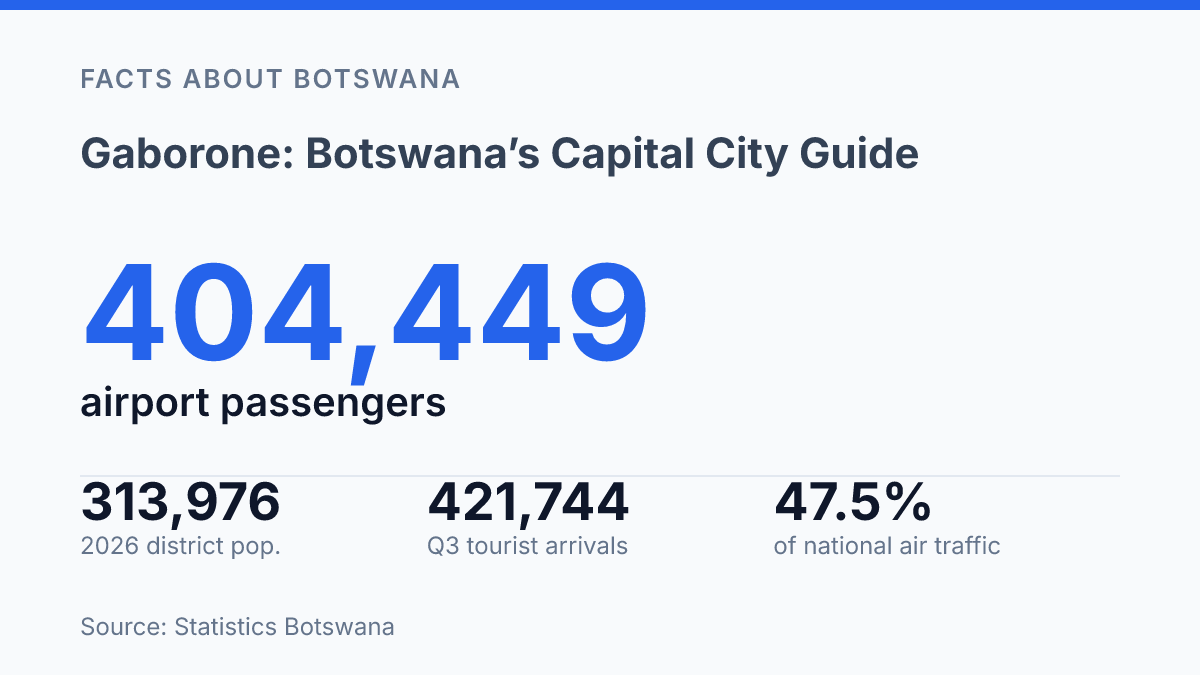
Gaborone is on track to reach 313,976 people in 2026, yet its real surprise is how fast the capital shifts from airport gateway to antelope territory.
Statistics Botswana projects the district to grow from 302,781 people in 2024. That is only 3.7% in two years.
But in a small national capital, that kind of growth changes traffic, hotels, dining. The feel of whole districts.
The city also carries more weight than its size suggests. Sir Seretse Khama International Airport handled nearly half of Botswana’s air passenger movements in 2024. From there, you’re close to game drives, Kgale Hill views, archaeological traces, malls, museums. The everyday rules that make travel smoother.
In my honest opinion, its edge is not polish. It is proximity. The capital works best when you treat it as a base with teeth, not a layover with a few errands attached.
Why Botswana’s capital matters now
A settlement founded in 1890 had to become a national capital almost overnight in 1966. Gaborone became Botswana’s capital after independence. That timing still shapes how the city feels.
It carries the confidence of a planned seat of government. It doesn’t have the slow, layered sprawl of many older capitals.
The South African border sits close enough to shape daily life, not just foreign policy. Government offices, transport routes, business services, and cross-border trade all meet here. That makes the capital a practical administrative and commercial hub for Botswana.
It also creates pressure. A city tied so closely to movement has to manage people, goods, permits, and expectations at the same time.
Growth is the real story behind its current importance. The district is projected to reach 313,976 people in 2026, up from 302,781 in 2024, according to Statistics Botswana, Population Projections for Botswana 2011–2026.
That’s roughly 3.7% growth in two years, a sharp rise for a capital that still feels compact by regional standards. The longer pattern matters more: its population growth has outpaced many older capitals in southern Africa.
In my view, Gaborone looks orderly on the surface. That calm planning hides how fast the city has had to adapt to growth. Wide roads and official buildings can make the place seem settled.
Look closer, though. You see a capital still negotiating its role: national symbol, service center, trade node, and home for a rising urban population. That mix is why the city matters now.
Wildlife close to the city center
A reserve the size of a few city neighborhoods can put wildebeest, impala, and commuter traffic within the same morning. Gaborone Game Reserve sits inside the city limits, not at the end of a long bush-road transfer. According to Lonely Planet, it covers just 5 sq km and was established in 1988, about 1 km east of Broadhurst Mall.
That compact scale is the point. You shouldn’t arrive expecting vast herds or a full wilderness illusion. The draw is stranger and more urban than that: wildebeest, impala, ostrich, warthog, and waterbirds living close to offices, shops, schools, and suburbs.
The reserve also rewards slower visitors. Resident birds and seasonal migrants give the place a rhythm that big mammals alone can’t provide.
Mokolodi Nature Reserve stretches the experience beyond the city’s edge. Southwest of the center, it’s known for rhinos and giraffes, but its role is broader than animal sightings. The reserve says it covers 3,700 hectares, receives over 60,000 visitors a year, and hosts more than 9,000 schoolchildren annually.
That education work matters. It turns wildlife from a tourist extra into something local families and students meet early.
Proximity is the city’s great trick, but it’s also the pressure point. Roads, suburbs, noise, and visitor demand press close to protected land.
Fences make the relationship possible. They also remind you how managed it is.
The best visits here come with adjusted expectations. Look for tracks, pause at water, and give the birds as much attention as the antelope. In my honest opinion, the birdlife is where the city’s wildlife story feels most honest, because it shows movement between protected pockets rather than pretending the urban edge doesn’t exist.
Hilltop views and cultural stops
From the top of Kgale Hill, the capital looks less like a planned grid than a city negotiating with open land. Footpaths lead up to the summit, where the view spreads across neighborhoods, roads, shopping areas. The dry ridges beyond.
The climb gives you scale fast. You see how compact the center can feel, then how quickly the city loosens at its edges.
The hill rises 1,287 metres above sea level, according to a University of Botswana article in Botswana Notes and Records. That height doesn’t make it a mountaineering test.
It does make timing matter. Go early or late, bring water, and don’t treat the walk as a quick photo stop if the heat is sharp.
A different kind of perspective waits in the city center at the National Museum and Art Gallery. It displays art and cultural artifacts, but its value isn’t just that it “has exhibits.” The museum gives shape to the country’s visual culture, historical memory, and public storytelling in a way a viewpoint can’t.
In my humble opinion, Kgale Hill gives you the better read on Gaborone than a car tour does. The museum gives the deeper one. That contrast is the point.
One shows you the city’s physical spread. The other slows you down enough to ask what that growth sits on.
In a single day, the pairing works cleanly. Start with the hill before the sun gets harsh, then move into the center when indoor time feels useful rather than forced. The museum also suits the middle of the day, when walking long distances loses its charm.
The hill area has another layer that most quick visits miss. The same University of Botswana article, published in 2019, discusses nearby Kgale View archaeological deposits with dates reaching deep into prehistory. You don’t need to turn the outing into a research trip.
That detail changes the mood. This isn’t just a lookout above a modern capital… it’s a high point beside a much older human record.
What visitors should expect on the ground
Nearly half of Botswana’s air passengers pass through one airport on the capital’s edge, so many visitors meet the city before they meet the country. Sir Seretse Khama International Airport handled 404,449 passenger movements in 2024, equal to 47.5% of Botswana’s total air passenger movements, according to Statistics Botswana. That makes arrival simple. It also makes the city feel more like a working gateway than a grand ceremonial capital.
Gaborone is compact compared with many African capitals. That matters if you only have a short stay. You can cover official districts, retail areas, and several key stops without losing half a day to distance.
The layout still favors car travel, though. Walking between major points can feel exposed, spread out, and less rewarding than the map suggests.
That convenience has a tradeoff. The city is easy to read.
That same clarity can make it feel less dramatic than visitors expect. There are broad roads, government buildings, malls, office blocks, and open plots rather than dense historic quarters. In my view, the city makes more sense when you stop looking for spectacle in the center and notice how quickly the edges open up.
Practical movement works best with a hired car, hotel transfer, taxi, or app-based ride where available. You’ll spend less time figuring out routes and more time choosing what kind of day you want. The center gives you administration and errands.
Shopping areas give you supplies, banks, and everyday city life. Nearby reserves shift the mood fast, without requiring a long expedition.
Security and payment habits should stay practical, not anxious. The U.S. Department of State issued Botswana a Level 2 advisory on June 17, 2026, citing crime, and says credit cards work in major cities but can be limited outside urban areas. Keep normal city awareness, carry some cash for smaller stops, and plan transport before late returns.
The reward is a capital that doesn’t fight you. It lets you move, adjust, and reach open space with surprising ease.
What this means before you book your time in the capital
When a 5 sq km reserve founded in 1988 sits near malls, and Mokolodi Nature Reserve draws more than 60,000 visitors a year, the smartest plan is not to rush through the capital. Give it a real day. Two is better.
Still, don’t confuse ease with sameness. Cards work well in the city, but less so beyond it.
Safety advice deserves attention, even when national offence numbers fall. That tension is part of the place.
In my humble opinion, the best visits here come from practical curiosity. Book the transfer, carry some cash, check the advisory, then leave room for the hill, the reserve. The ordinary street that tells you more than a brochure ever will.
Frequently Asked Questions
Q: What is Gaborone best known for?
A: Gaborone is best known for being Botswana’s capital and for how close it keeps nature to the city center. You can see wildlife at the Gaborone Game Reserve, then switch to art and history at the National Museum and Art Gallery. That mix matters. It’s a city trip that doesn’t feel sealed off from the country around it.
Q: Is Gaborone worth visiting for a short trip?
A: Yes, if you want a capital that feels practical but not dry. You can fit in the museum, a reserve visit. A hill walk without wasting time crossing a huge city. In my view, that’s what makes it a smart stop, not just a place to pass through.
Q: Can you see wildlife near Gaborone?
A: Yes. The Gaborone Game Reserve shelters native animals like wildebeest and impala, plus resident and migratory birds. To the city’s southwest, Mokolodi Nature Reserve has rhinos and giraffes… so you get real wildlife access without leaving town for hours.
Q: What can you do at Kgale Hill?
A: Kgale Hill is a strong choice if you want a clear city view without a complicated hike. Footpaths lead to the summit, so it’s straightforward for most visitors. The surprise is how fast the climb feels compared with the payoff at the top.
Q: Where should I go for culture in Gaborone?
A: Start with the National Museum and Art Gallery in the city center. It shows art and cultural artifacts. You get a direct look at Botswana’s history and creative life. That balance is useful after a wildlife stop. The city feels more complete when you do both.